

A molecular pump unit should be selected as a vacuum system, not as a high-speed pump with the largest nominal pumping speed. The chamber volume, gas load, target pressure, inlet conductance, backing pump, valves, cooling, controls and process contamination determine whether the installation reaches pressure reliably and repeats the result over years.
Century Hongtu’s JTFB range includes grease-lubricated turbomolecular pumps and complete molecular pump units. Its JTFB-2000Z page describes an integrated controller, ceramic bearings, any-angle installation and protection functions for electrical and thermal faults. Buyers comparing Century Hongtu turbomolecular pumps should still begin with a written duty cycle. A pump model is only one component in the pressure path.
Define the vacuum process before comparing pump speed
Record the chamber volume, initial pressure, required base pressure, process pressure, allowable pump-down time and time spent at each stage. Then list gas sources: chamber outgassing, seals, feedthroughs, intentional gas flow, process vapour, leaks and product load. A clean, empty research chamber behaves differently from a production chamber that repeatedly receives warm or porous parts.
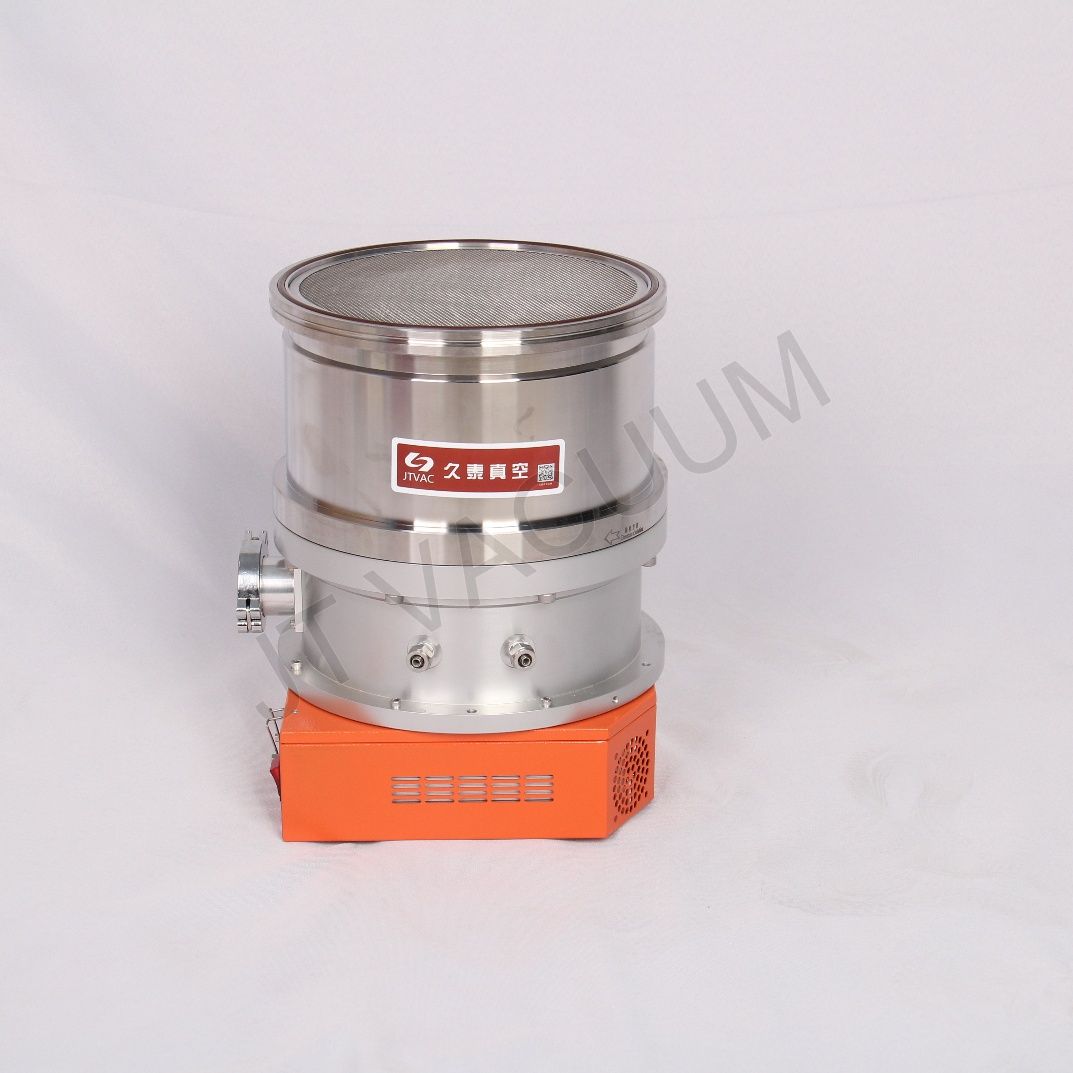
The JTFB-2000Z combines a turbomolecular pump and controller, but system performance still depends on backing, conductance and process conditions.
Nominal pumping speed is measured under defined test conditions at the pump inlet. The chamber sees an effective speed reduced by pipe conductance, bends, valves, screens and restrictive ports. A large pump behind a narrow line may offer little improvement at the work volume. Before increasing pump size, calculate or measure the conductance of the actual connection.
The backing pump sets the turbopump's working foundation
A turbomolecular pump cannot normally exhaust directly to atmosphere. It needs a forevacuum or backing pump to reduce exhaust pressure and bring the chamber into the molecular pump’s acceptable starting region. The required backing speed depends on gas throughput, foreline pressure limit and operating mode, not just the turbopump inlet rating.
If the backing pump is undersized, contaminated or connected through a restrictive foreline, exhaust pressure rises and the turbopump may run hot, draw excessive power or alarm. If the process introduces continuous gas, size the backing stage for that throughput. For batch evacuation with little process gas, chamber pump-down and desired crossover time may dominate.
Prevent oil and particles from moving in the wrong direction
Where a clean high-vacuum environment is required, consider a dry backing pump or suitable traps and operating procedures. An oil-sealed rotary-vane pump can be economical, but backstreaming and mist control need attention. Install foreline filters only after checking their conductance and maintenance burden. A dirty filter can quietly become the main restriction in the system.
Valve sequencing should isolate the high-vacuum pump during backing faults and power loss. Define what happens when the roughing pump stops, cooling fails or a valve position signal is lost. Safe automatic response is part of pump-unit design.
Gas species affects compression and achievable pressure
Turbomolecular pumps generally compress heavier gas molecules more strongly than very light gases. A system dominated by hydrogen or helium can therefore require a different performance review from one pumping nitrogen or air. Ask for pumping-speed and compression data for the gases that matter, not only a single headline value.
Ultimate pressure also depends on chamber material, cleanliness, bakeout, seals and measurement. A pump specification cannot guarantee that a contaminated elastomer-sealed chamber will reach an ultra-high-vacuum target. The vacuum gauge type, location and calibration should be defined with the target pressure.
Integrated controller features reduce installation work, not engineering responsibility
The JTFB-2000Z product page states a maximum controller output frequency of 400 Hz and maximum speed of 24,000 rpm. It describes sensorless control, an HMI, online software upgrade and alarms or protection for overcurrent, overvoltage, undervoltage, motor and controller temperature, overload, motor disconnection, short circuit, starting failure and other faults.
These features can simplify commissioning, but the purchaser should request the I/O list, communication protocol, interlock logic and alarm history behaviour. Confirm how the pump interfaces with the chamber PLC, gauges, valves, cooling-flow switch and emergency stop. Decide which faults command a controlled deceleration, immediate isolation or process abort.
Software upgradeability is useful only with version control. Record installed firmware, parameter backup and the change procedure. A production line should not receive an untested controller update simply because remote upgrade is possible.
Grease-lubricated bearings change the maintenance conversation
Century Hongtu states that the JTFB-2000Z uses imported precision ceramic bearings lubricated with grease and that the complete rotor is mechanically balanced. Grease lubrication avoids an external oil-lubrication system and can support flexible mounting. It does not make bearings maintenance-free.
Bearing life is influenced by speed, temperature, vibration, gas load, venting, process deposits and handling. Ask for recommended inspection or service intervals and the conditions that shorten them. Establish whether bearing service is performed on site, at a regional centre or only at the factory, and what turnaround and exchange options are available.
Noise, heat and power are condition indicators
The product page warns that poor bearing condition can appear as failure to start, increased operating noise or abnormal temperature or power. These signals should become part of the facility’s maintenance record. Establish a normal baseline after commissioning: run-up time, steady-state current or power, housing temperature, vibration and sound.
A trend away from baseline is more informative than waiting for a shutdown alarm. First exclude external causes such as excessive inlet or exhaust pressure, cooling failure and process contamination. If the abnormality remains, stop the pump according to the manufacturer’s procedure rather than continuing until a high-speed rotor fails.
Cooling must cover the worst operating condition
A turbomolecular pump generates heat through the motor, bearings and gas compression. Available JTFB-2000 variants include air- and water-cooled arrangements. Select cooling based on ambient temperature, gas throughput, mounting enclosure and production duty, not convenience alone.
Water cooling requires specified flow, inlet temperature, water quality and leak management. Fit a flow interlock if loss of cooling can damage the pump. Air cooling needs unobstructed intake and discharge and may be unsuitable in a hot, dusty cabinet. During site acceptance, test the system at the highest expected gas load and ambient temperature.
Any-angle mounting still needs structural and process review
The JTFB-2000Z page states that the grease-lubricated pump can be installed at any angle. That gives layout flexibility, but the chamber flange and support must carry pump mass and reaction loads without distortion. A large pump should not hang from a thin chamber wall with pipework used as support.
Orientation also affects where process particles or condensable material may fall. A downward-facing inlet can create different contamination risk from an upright installation. Confirm allowable mounting positions for the exact model, include a support drawing and provide access for removal and service.
Venting is a controlled process, not simply admitting air
After shutdown, the high-speed rotor must decelerate under controlled conditions. Venting too quickly can create aerodynamic load, move particles and place stress on bearings. Venting too late may allow contamination or backing-pump oil to migrate. Use the manufacturer’s recommended vent valve, gas, timing and pressure rise.
For sensitive chambers, dry nitrogen venting may reduce moisture and particulate exposure. Locate the vent connection so that gas flow does not drive debris into the pump. Integrate venting with valve and speed signals rather than relying on manual timing.
Process contamination may decide whether a standard turbopump is appropriate
Clean gases in research or electronics applications are relatively straightforward. Corrosive, condensable, polymerising or particulate processes require additional analysis. Deposits on rotor and stator blades can reduce performance and unbalance the rotor; corrosive gases can attack internal surfaces; liquids can cause immediate damage.
Tell the manufacturer every process gas, vapour, concentration and possible by-product. Discuss purge, heated lines, traps, isolation and cleaning. If the process is incompatible, a different pump technology or specially configured turbopump may be necessary. Never treat a general statement of chemical-industry use as approval for a specific hazardous gas.
Vacuum gauges and leak testing verify the complete unit
Use appropriate rough- and high-vacuum gauges and place them where they represent chamber and foreline conditions. A gauge mounted close to the pump may read better than the work volume during gas load. Calibration and contamination affect readings, so record gauge model, range and status during acceptance tests.
Leak testing should distinguish real leaks from outgassing. Pressure-rise tests can reveal the combined gas load, while helium leak detection can locate specific leaks where suitable. Acceptance criteria should include pump-down time, base pressure, pressure rise, operating temperature and alarm checks, not merely that the pump reaches full speed.
Ask the manufacturer for a complete unit proposal
A request for turbomolecular pump products should include chamber volume and material, target pressure, gas composition and flow, required cycle, port size, orientation, ambient conditions, utilities and control interface. Ask the supplier to state the selected turbopump, backing pump, valves, gauges, hoses, cooling and controller as one bill of materials.
Request performance curves, allowable foreline pressure, crossover conditions, flange standard, vibration data, electrical supply, cooling requirement, controller I/O and dimensional drawings. Clarify included cables and accessories. Small missing items at commissioning can delay a vacuum project more than the pump itself.
Long-term stability comes from operating discipline
Create startup and shutdown sequences, alarm-response instructions and maintenance logs before production begins. Train operators not to open valves against the wrong pressure differential or vent a spinning pump without the approved sequence. Keep foreline filters, backing-pump consumables and critical seals in the spare-parts plan.
Track run hours, start cycles, bearing-service dates, fault codes, power, temperature and pump-down performance. This makes predictive maintenance possible and gives the manufacturer useful evidence when troubleshooting.
The core selection principle is straightforward: a molecular pump does not create stable vacuum alone. The JTFB-2000Z’s integrated controls, grease-lubricated ceramic bearings, mounting flexibility and protections are valuable only when conductance, backing, cooling, venting and contamination are engineered around them. Specify the complete pressure path and life-cycle service before comparing price, and the resulting unit will be far more likely to meet both the first acceptance test and years of daily operation.
